1 st   rule  of Fight club social  networking be   social   “ Welcome to an  element of  Web 2.0 … you’ll love it ”   ;)
An overview of  social media be   social
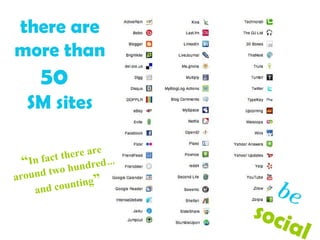
be   social  there are more than 50  SM sites “ In fact there are  around two hundred … and counting ”
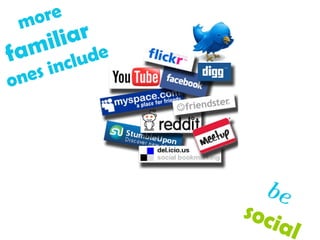
be   social  more  familiar   ones include
be   social  but the  most  popular  are:  plus:
some  useful  info  Twitter:  Launched in July 2006. 190 million users Facebook:  Launched in Feb 2004. 500 million users LinkedIn:  Launched May 2003. 20 million users Myspace:  Launched Aug 2003. 60 million users Youtube:  Launched Feb 2005. Flickr:  Launched Feb 2004. be   social
So what are  they  good  for ?   Absolutely  everything ! Social media platforms allow you to communicate with your preferred audiences They allow organisations to connect with consumers and stakeholders If used correctly they replace or support some traditional advertising and media channels Social media platforms have now taken over traditional media  They allow you to connect and monitor content that’s of interest to your client IMPORTANLY , they allow everyone to have an opinion ! They directly support search engine optimisation be   social
what are  they ?   Twitter:  mircoblogging site Facebook:  Content driven site Youtube:  Online video hosting service Myspace:  Content driven site LinkedIn:  Professional social network site Technorati:  Blog search engine Delicious:  Social booking marking site Flickr:  Photo/video hosting service be   social
Social media platforms started to gain importance after 2004. The pr, marketing, advertising and sales professions all started – slowly – to see how social media could help them engage with consumers, stake holders and the media. Social media are online platforms that enable people to interact and communicate  with other people. Social media and the digital revolution facilitates consumer journalism. Social media allows you to represent your clients’ interests online. Now  everyone   has a voice – good or bad Social media forms part of the web 2.0 - the  evolution  of PR !  an  overview :   be   social
popular  speak :   Tweets:  updates on twitter Tags:  keywords attached to blog posts, images, etc RSS:  really simply syndication – an alert service Aggregation:  gathering and remixing content on one platform to another Social networks:  tools to create and share profiles and publicise content Widgets:  stand alone applications commonly used in advertising Avators:  images representing people  Blogroll:  regular read sites by another blogger Feeds:  available content you can read, listen or view  Lurkers:  people who view but never contribute Social media:  tools and platforms to share content Threads:  strands of conversation Trackback:  calling cards used on blogs  Astroturfing:  PR produced blogs to give impression of a personal weblog be   social
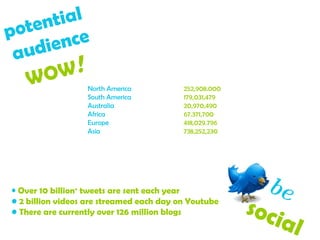
potential  audience WOW !  North America 252,908.000 South America 179,031,479 Australia  20,970,490 Africa 67.371,700 Europe 418,029.796 Asia 738,252,230 Over 10 billion +  tweets are sent each year 2 billion videos are streamed each day on Youtube There are currently over 126 million blogs be   social
So which one ?   From a professional perspective selecting which social media to use is the same process as  picking traditional media channels – it depends on your audience, your message and your objective. For example:   Twitter is good for corporate statements, targeting media and supporting SEO Facebook is great for interacting with your audience and attracting feedback Over 10 billion +  tweets are sent each year 2 billion videos are streamed each day on Youtube There are currently over 126 million blogs “ Although  they are  both  great public  engagement   Tools” be   social
did you know :   Two thirds  of the internet population visit social networks Social networks account for  10%  of all internet time 37%  of internet users use social network sites daily 25%  of online consumers read blogs and  14%  comment on them 36%  think more positively about companies with blogs 76%  of consumers use online reviews when making purchases be   social
Pro ’ s and con ’ s of using SM :   Pro’s: Allow direct communication with consumers Provide real time buzz  Enable interaction with desired publics Enable corporations to build relationships with desired publics Con’s: Lack of control  be   social
considerations :   Assess and understand your clients objectives  Decide how social media can be used to achieve the objectives Select appropriate social media tools: Based on capabilities and target audience Outline tactics for engagement: Begin by spending time on the community be   social
measuring your clients ROI :   Increase in brand loyalty ( repeat customers ) Stronger brand image Increased buzz ( chats, positive comments ) Site traffic Increase in fans/followers/subscribers Increased conversation Increased registration Google page ranking be   social
2 nd   rule  of Fight club be   social   “ Welcome to an  element of  Web 2.0 … you’ll love it ”   ;) social  networking

Introduction on how to be social

  • 1.
    1 st rule of Fight club social networking be social “ Welcome to an element of Web 2.0 … you’ll love it ” ;)
  • 2.
    An overview of social media be social
  • 3.
    be social there are more than 50 SM sites “ In fact there are around two hundred … and counting ”
  • 4.
    be social more familiar ones include
  • 5.
    be social but the most popular are: plus:
  • 6.
    some useful info Twitter: Launched in July 2006. 190 million users Facebook: Launched in Feb 2004. 500 million users LinkedIn: Launched May 2003. 20 million users Myspace: Launched Aug 2003. 60 million users Youtube: Launched Feb 2005. Flickr: Launched Feb 2004. be social
  • 7.
    So what are they good for ? Absolutely everything ! Social media platforms allow you to communicate with your preferred audiences They allow organisations to connect with consumers and stakeholders If used correctly they replace or support some traditional advertising and media channels Social media platforms have now taken over traditional media They allow you to connect and monitor content that’s of interest to your client IMPORTANLY , they allow everyone to have an opinion ! They directly support search engine optimisation be social
  • 8.
    what are they ? Twitter: mircoblogging site Facebook: Content driven site Youtube: Online video hosting service Myspace: Content driven site LinkedIn: Professional social network site Technorati: Blog search engine Delicious: Social booking marking site Flickr: Photo/video hosting service be social
  • 9.
    Social media platformsstarted to gain importance after 2004. The pr, marketing, advertising and sales professions all started – slowly – to see how social media could help them engage with consumers, stake holders and the media. Social media are online platforms that enable people to interact and communicate with other people. Social media and the digital revolution facilitates consumer journalism. Social media allows you to represent your clients’ interests online. Now everyone has a voice – good or bad Social media forms part of the web 2.0 - the evolution of PR ! an overview : be social
  • 10.
    popular speak: Tweets: updates on twitter Tags: keywords attached to blog posts, images, etc RSS: really simply syndication – an alert service Aggregation: gathering and remixing content on one platform to another Social networks: tools to create and share profiles and publicise content Widgets: stand alone applications commonly used in advertising Avators: images representing people Blogroll: regular read sites by another blogger Feeds: available content you can read, listen or view Lurkers: people who view but never contribute Social media: tools and platforms to share content Threads: strands of conversation Trackback: calling cards used on blogs Astroturfing: PR produced blogs to give impression of a personal weblog be social
  • 11.
    potential audienceWOW ! North America 252,908.000 South America 179,031,479 Australia 20,970,490 Africa 67.371,700 Europe 418,029.796 Asia 738,252,230 Over 10 billion + tweets are sent each year 2 billion videos are streamed each day on Youtube There are currently over 126 million blogs be social
  • 12.
    So which one? From a professional perspective selecting which social media to use is the same process as picking traditional media channels – it depends on your audience, your message and your objective. For example: Twitter is good for corporate statements, targeting media and supporting SEO Facebook is great for interacting with your audience and attracting feedback Over 10 billion + tweets are sent each year 2 billion videos are streamed each day on Youtube There are currently over 126 million blogs “ Although they are both great public engagement Tools” be social
  • 13.
    did you know: Two thirds of the internet population visit social networks Social networks account for 10% of all internet time 37% of internet users use social network sites daily 25% of online consumers read blogs and 14% comment on them 36% think more positively about companies with blogs 76% of consumers use online reviews when making purchases be social
  • 14.
    Pro ’ sand con ’ s of using SM : Pro’s: Allow direct communication with consumers Provide real time buzz Enable interaction with desired publics Enable corporations to build relationships with desired publics Con’s: Lack of control be social
  • 15.
    considerations : Assess and understand your clients objectives Decide how social media can be used to achieve the objectives Select appropriate social media tools: Based on capabilities and target audience Outline tactics for engagement: Begin by spending time on the community be social
  • 16.
    measuring your clientsROI : Increase in brand loyalty ( repeat customers ) Stronger brand image Increased buzz ( chats, positive comments ) Site traffic Increase in fans/followers/subscribers Increased conversation Increased registration Google page ranking be social
  • 17.
    2 nd rule of Fight club be social “ Welcome to an element of Web 2.0 … you’ll love it ” ;) social networking